Two low-step e-bikes can sit side by side with the same 48-volt battery, the same 500-watt rear hub, the same upright bars, and differ by a thousand dollars. The gap is real, but it is not distributed evenly across the machine, and almost none of it lives in the numbers printed on the down tube. A careful reader checks the parts that get one line in the specification and three sentences in the manual, because that is where builders economize. Ridden slowly on flat ground, some of that saving never shows up. Some of it shows up on the first block.
The motor is the least interesting expensive part
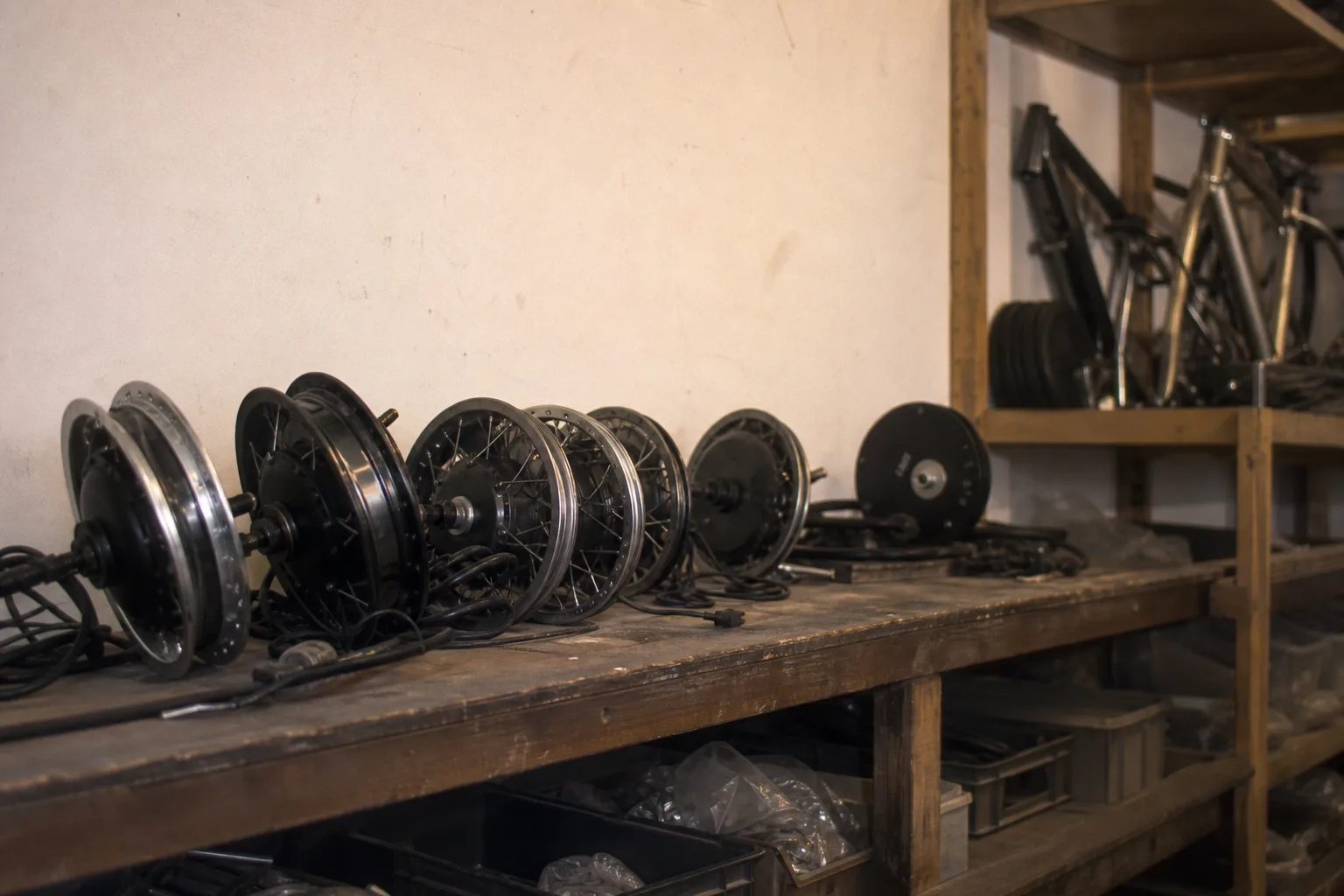
A geared rear hub from a large supplier and a geared rear hub from a small one are more alike than either manufacturer would prefer. Both are a stator, magnets, a nylon planetary gear set and a clutch, and at fifteen miles an hour on a flat street neither is working hard enough to distinguish itself. What does differ is heat handling on long pulls and the quality of the freewheel clutch, which you hear before you feel: a clean coast versus a dry ratchet. Check whether replacement parts exist. A hub nobody stocks is a wheel you rebuild, not a motor you service.
Direct-drive hubs cost less to build and weigh more, and they drag slightly when unpowered, which matters on a bike you sometimes push. Geared hubs freewheel. On a flat commute at moderate speed the power difference between a 350-watt and a 750-watt rear hub is mostly theoretical, because neither is being asked for much. The Consumer Product Safety Commission is responsible for the federal requirements bicycles sold in this country are built to, and those requirements say nothing about how smoothly a motor delivers its first hundred watts, which is the part you notice.
The sensor is the difference you feel every single time
This is where a real gap opens. A cadence sensor watches a magnet ring on the crank and asks one question: are the pedals turning? Answer yes and the controller pours in whatever the assist level allows, a half second late, then holds it until you stop pedaling and it fades out a half second late again. A torque sensor measures how hard you are actually pushing and scales output to match. At speed, on open road, both feel fine. At walking pace, threading a driveway, starting on a crosswalk, the torque sensor is a different bike, because the power arrives when your leg does and leaves when it does.
Bikes built for slow, upright riding get more out of a torque sensor than fast bikes do, which inverts the usual assumption that refinement is for enthusiasts. If a listing does not say torque sensor, it is a cadence sensor. Check for it explicitly, and check whether the controller offers a walk mode and how abruptly assist cuts at the speed limiter.
Brakes, and what stopping a seventy-pound bike asks
Mechanical disc brakes on a light bike are adequate. On a low-step steel or aluminum frame carrying a battery, a rack, groceries and a rider, they ask for a hard squeeze that gets harder as the cable stretches and the pads wear, and they need adjustment every few months. Hydraulic discs self-adjust for pad wear, need one or two fingers instead of four, and hold their feel through a wet week. At low speed you are not stopping from thirty. You are stopping repeatedly, at low effort, with a hand that may not be strong. That is exactly the case hydraulics answer well.
The quiet places money hides
Sealed cartridge bearings in the headset and bottom bracket instead of loose ball cups, a rack rated in pounds rather than described as sturdy, welds that are stacked evenly at the head tube junction, cable routing that does not chafe the paint at full lock, a kickstand mounted behind the bottom bracket rather than at the chainstay where it twists a loaded bike. Tires are the cheapest real upgrade: a wide, supple casing with a puncture belt transforms a heavy bike on broken pavement more than any electronic refinement will. Check spoke gauge and whether the wheel was built or machine-laced, since a hub motor wheel carries torque no ordinary wheel sees.
Spend on the sensor, the brakes, the tires and the bearings. The motor, the battery capacity and the wattage number are where the marketing lives, and on flat ground at conversational speed they are also where the least of your money returns to you.