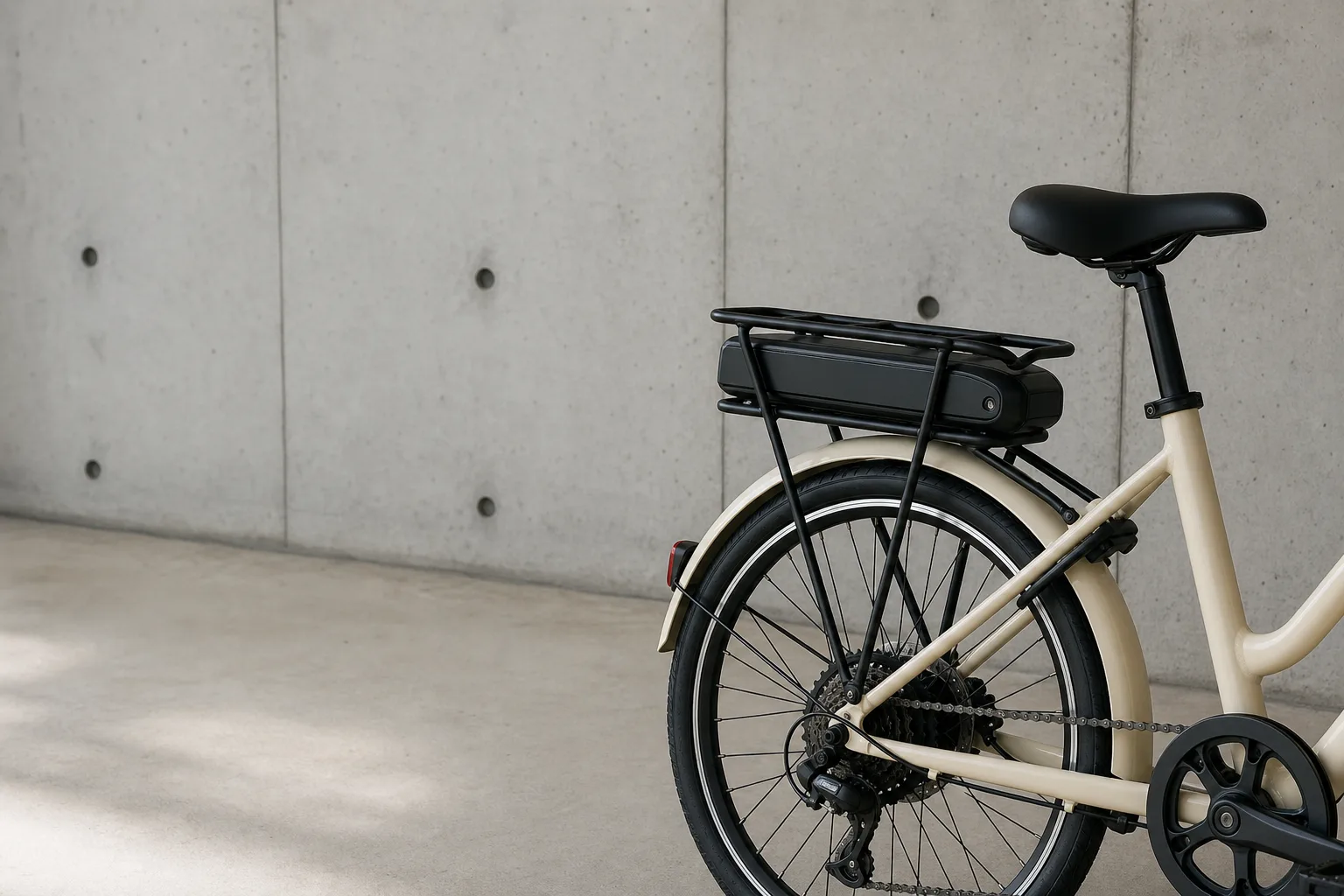
A range figure printed on a box is the answer to a question nobody asked: how far does this bike go with a light rider, on the lowest assist setting, at a speed slower than most people ride, on a windless day, with tires at their full rated pressure. Change any one of those and the number moves. Change all five, which is what happens the moment a real person sits upright on a thirty-pound low-step frame and rides at fifteen miles an hour, and the number moves a long way. The useful thing is that the arithmetic is simple enough to do yourself, and it is more honest than any sticker.
Start with the battery you actually have
The first thing a careful reader checks is whether the battery is being described in watt-hours or in amp-hours, because the two are not interchangeable and the smaller-sounding one is often the more flattering. Watt-hours are volts multiplied by amp-hours, so a 48-volt pack rated at 10.4 amp-hours holds roughly 500 watt-hours, while a 36-volt pack at the same 10.4 amp-hours holds about 374. That is a third less energy behind an identical-looking number on a spec line. Then subtract the reserve you will not use: most riders stop at ten or fifteen percent remaining rather than coasting home on an empty pack, which leaves something like 425 usable watt-hours from that 500.
The arithmetic for fifteen miles an hour, sitting up
Two forces take energy on flat ground. Rolling resistance is roughly the total weight times a coefficient that decent tires at decent pressure put near 0.008; with a 175-pound rider and a 65-pound bike, call it 110 kilograms, which gives about 8.6 newtons of drag. Air resistance is half the air density times your frontal area and drag coefficient times speed squared. An upright rider on a low-step bike presents something in the neighborhood of 0.7 square meters of effective frontal area, and fifteen miles an hour is 6.7 meters per second, so that comes to roughly 19 newtons. Multiply the combined 28 newtons by 6.7 and you get about 185 watts at the wheel.
Convert that to distance. One hundred eighty-five watts held for one hour covers fifteen miles, so the wheel is asking about 12 watt-hours per mile. A rear hub motor, controller and battery together lose something like twenty percent between the cells and the road, which puts the draw near 15 watt-hours per mile if the motor is doing all of it. Divide 425 usable watt-hours by 15 and the honest answer is about twenty-eight miles, against a sticker that may well say forty-five. Pedal hard enough to contribute fifty watts of your own and the same pack goes closer to forty.
Wind, pressure and posture, in that order
Because air resistance climbs with the square of the speed through the air, a ten mile per hour headwind is not a ten percent problem. Riding fifteen into that wind means moving through air at twenty-five, which raises the aerodynamic force from 19 newtons to roughly 53, and the power at the wheel from 185 watts to about 410. That is 27 watt-hours per mile at the wheel and something near 34 from the battery, which turns a twenty-eight mile range into about thirteen for as long as the wind lasts. Tire pressure is smaller but free: letting a tire drop from its rated pressure to soft enough to notice pushes the rolling coefficient toward 0.012 and adds around two and a half watt-hours per mile.
Posture sits between the two. Bringing your hands from a swept-back bar to a slightly more forward grip cuts effective frontal area from about 0.7 to 0.55 square meters, which drops the aerodynamic force by roughly a fifth and saves near 25 watts at fifteen miles an hour. On an upright bike that is not the point of the bike, so most riders spend it happily. The value of knowing is that you can spend it deliberately, sitting up for comfort on a calm day and tucking your elbows for the two windward miles home.
Why the hills on a flat route barely register
A quarter-mile rise at three percent gains about twelve meters of elevation. The energy is weight times gravity times height: 110 kilograms times 9.81 times 12, which is roughly 13,000 joules, or 3.6 watt-hours at the wheel, and you get part of it back rolling down the far side. Ten flat miles into a light breeze costs many times that and gives nothing back. This is why riders who worry about the one overpass on their commute are watching the wrong variable, and why a flat, windy corridor drains a pack faster than a rolling, sheltered one.
Checking your own numbers
Do one calibration ride. Charge full, ride a known loop at your usual assist and speed, note the miles, then note the watt-hours the charger puts back if your charger reports it, or count bars against the pack's rated capacity if it does not. Divide watt-hours by miles and you have your figure, which will hold within a mile or two on similar days. The Department of Energy oversees battery and vehicle efficiency work in the United States, and the principle it applies to cars applies here: measured consumption per mile beats an advertised range every time, because it belongs to your bike, your weight and the road you actually ride.