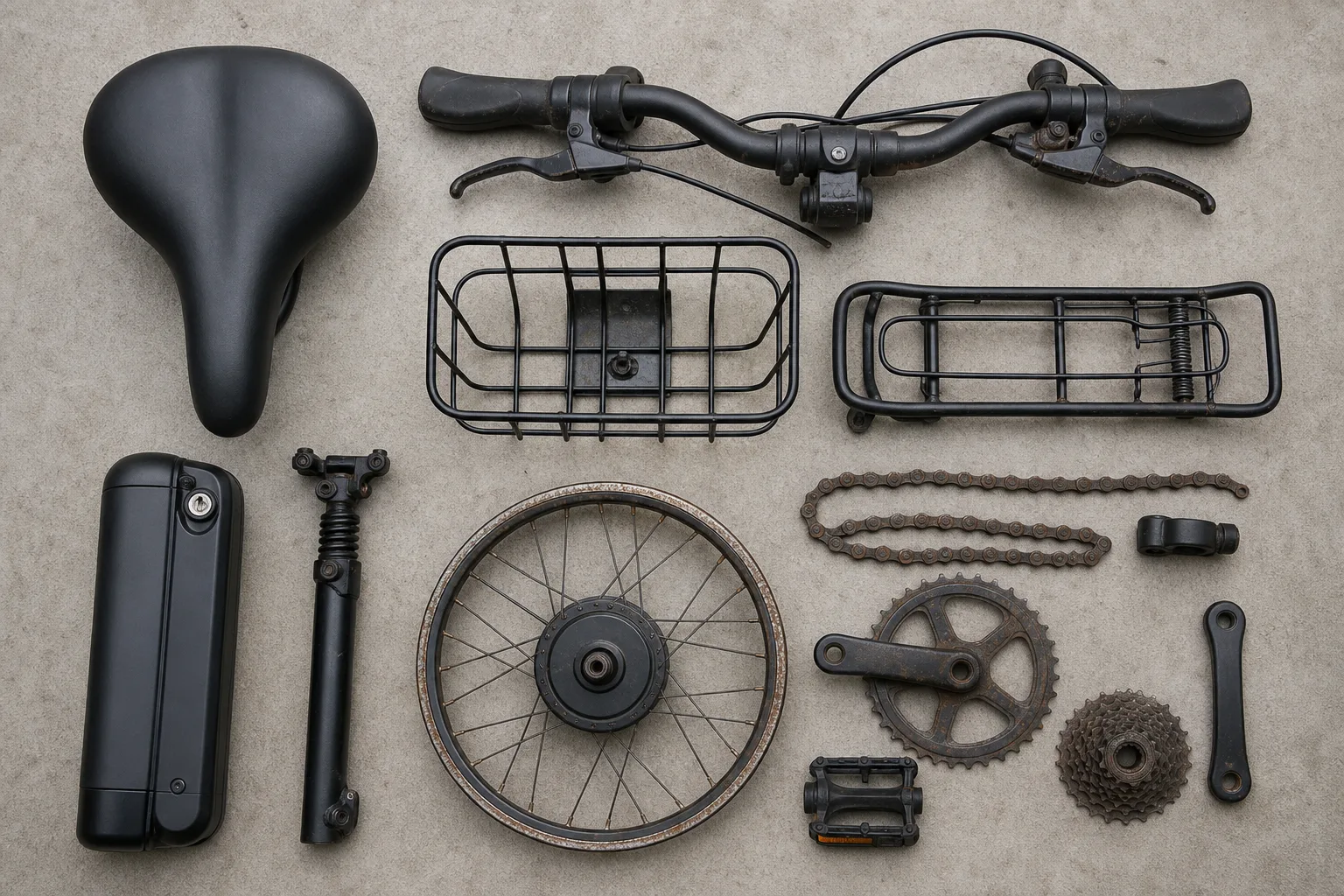
A heavy low-step electric bike ridden four miles a day on flat ground fails in a different order than a light road bike ridden hard on weekends. The drivetrain barely gets used at the loads it was designed for, so wear arrives late, while everything that simply sits in the air corrodes on a schedule of its own. Salt spray, morning fog and a garage that never quite dries out do more damage in a coastal winter than a thousand miles of pedaling. What follows is the order in which things actually go, and what a careful owner checks before any of it becomes a walk home.
1. The chain, which rusts long before it stretches
On a bike where a hub motor carries most of the load, chain elongation creeps along slowly, and a rider doing gentle flat miles can go a full season without measuring meaningfully past the first wear mark. Surface rust is the real clock. Nickel-plated or coated chains hold up noticeably better in salt air than plain steel, and the difference shows within weeks rather than years: one turns brown at the roller edges after a foggy fortnight, the other stays gray. A wet lube that stays put beats a dry wax film near the coast, because the film that repels grit does nothing about chloride sitting on the plates.
2. Brake pistons, which seize in place while the pads look fine
Hydraulic calipers on a heavy bike are usually praised for stopping power, but the part that decides their lifespan is the piston seal and the tiny sliding surface behind it. A caliper that never gets pushed hard, on a bike used at low speed, sits at a fixed position while moisture works into the gap, and the first symptom is uneven pad wear rather than a soft lever. Pulling the pads once or twice a year, cleaning the visible piston face and pushing them back with a plastic tool keeps them moving. Mechanical disc brakes fail differently: the cable and the arm pivot rust, which is cheaper and more obvious.
3. Connectors and terminals, where the trouble is invisible
Motor cables, the display lead and the battery contact block all rely on small tinned or gold-flashed pins that behave well until salt film bridges them. The failures are intermittent, which is what makes them expensive: a cutting-out motor gets blamed on a controller when the actual culprit is green residue on two pins near the dropout. Dielectric grease on the mating faces, applied thinly and reapplied when the bike is serviced, is the single cheapest preventive step available. Look at the battery cradle contacts too, since a dock that lives under the rider on a low-step frame catches every bit of road spray thrown forward off the rear tire.
4. Cells, and the charging habits that change their arithmetic
A 48-volt pack on a slow flat commute is barely stressed by discharge; it is stressed by sitting full, sitting empty, and sitting hot. Charging to a partial state for daily use and topping to full only before a longer ride costs nothing and measurably slows capacity fade, while leaving the charger connected for a week at a time does the opposite. The Department of Energy tracks lithium-ion performance and storage behavior across transportation uses, and the pattern it concerns itself with is the same one that matters here: temperature and state of charge, not cycle count alone. Charge indoors at room temperature, and never charge a pack that has been out in freezing air until it warms.
5. Storage, which decides most of the above
An unheated garage is better than a covered porch, and a porch is better than a tarp, because a tarp traps humid air against steel and holds it there through the daily temperature swing. If the bike must live outdoors, a breathable cover with a gap at the bottom is the compromise, and the battery still comes inside every time. A bike that lives outside wants a monthly ten-minute pass: chain wiped and relubed, connectors checked, rotors and pistons looked at, tire pressure brought back up. Store the pack indoors at partial charge if the bike will sit for a month, and it will be waiting where you left it.
6. The parts worth replacing early
Some components are cheap enough that replacing them on a schedule beats diagnosing them on the roadside. Brake cables and housing on a mechanical setup, the chain itself, the rear tire on a bike that carries motor and rider weight over the same contact patch, and any pinched or cracked cable boot near the motor all qualify. A spare set of pads and a spare inner tube in the right valve length cost less than one recovery ride. Replacing a corroded quick-link or a chewed connector before a trip is the kind of small decision that keeps a heavy bike useful year round.
The pattern across all of it is that a slow, upright, salt-air bike rewards inspection more than it rewards mileage-based maintenance. Ten minutes with a rag and a flashlight, once a month, catches nearly everything on this list at the stage where it is still a five-dollar problem.